
Belt SkimmerMaximize the lifespan of valuable process fluids
How can you reliably remove tramp oils from process fluids? Many professionals in the metalworking industry are familiar with belt skimmers for removing tramp oils from cooling lubricants. What many people don’t realize is that a belt skimmer is just one design among many, and another type of skimmer might be the better choice for their specific application. Under what conditions is a belt skimmer the right choice, and when is a different design more suitable?
(Read the following article)
Toc:
- Why use belt skimmers at all?
- Typical Applications for Belt Skimmers
- Different Designs
- Special Version: Angled Belt Skimmer
- Variations in the Quality of Belt Skimmers
- Tube Skimmer
- Special Features of FRIESS Belt Skimmers
- Typical Applications of Belt Skimmers
- Buy Belt Skimmers from the Manufacturer FRIESS
- Belt Skimmer Replacement Belt
- Conclusion
- FRIESS Oil Skimmers
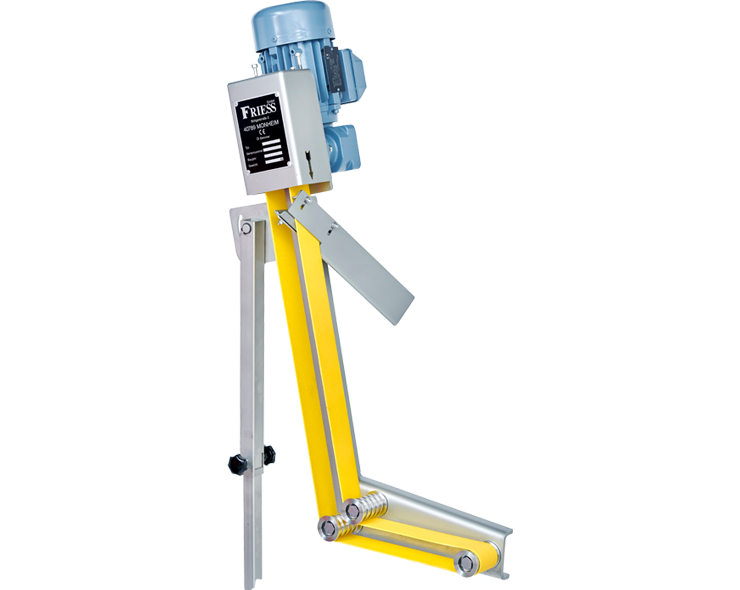
Cooling lubricants and other process fluids are expensive, so the goal is to maximize their service life. Removing tramp oil significantly extends the service life of the fluids, leading to significant cost savings. To ensure effective separation of the fluid and oil, proper sizing is crucial (belt skimmer capacity, tank size).
Belt skimmers are a type of oil skimmer that removes oil floating on the surface of liquids using a belt. This belt is submerged into the liquid, and the floating oil adheres to the belt, from which it is scraped off inside the skimmer itself. The belt is continuously driven to enable continuous oil removal.
Belt skimmers are typically used in smaller tanks. These are usually smaller coolant tanks designed to supply water-based coolants to metalworking machines, such as turning and milling centers.
Belt skimmers are often specifically developed and designed for this one application:
cooling lubricants. This is by far the largest area of application and, consequently, the largest market.
However, belt skimmers can also be used successfully in other areas, provided they are properly designed and key application parameters are observed.
In addition to cooling lubricant systems in metalworking, other areas of application include, for example, degreasing baths and systems in electroplating and coating systems. Belt skimmers are also used in washing systems in metalworking.
In general, however, belt skimmers are more suitable for and intended for use with small tanks and surfaces. In larger systems and on larger surfaces, belt skimmers often cannot handle the large volume of oil present, or the surface can no longer be kept completely free of oil due to the skimmer’s limited effective range.
In a nutshell
Belt skimmers are used wherever light, non-water-soluble substances (e.g., oil) settle on the surface of liquids in smaller tanks. They operate simply, energy-efficiently, and continuously—making them ideal for continuous industrial applications.
Free-Hanging deflection pulley
In belt skimmers, the belt must be guided in some way so that it is submerged in the liquid and remains reasonably taut.
In the case of belt skimmers with a loose deflection pulley, a deflection pulley is “hung” on the belt and essentially serves as a weight to anchor the belt and guide it into the liquid, since it would otherwise float.
A major advantage of this design is that the belt can be made as long as necessary to accommodate the required height or fluctuations in the tank’s liquid level.
Guided Deflection Pulley
A guided deflection pulley is attached to the body of the belt skimmer and thus not only hangs from the belt but also actively guides and tensions it. This design is often more expensive, as it requires additional engineering and installation work, but it offers various advantages. The belt can be actively tensioned, which ensures better belt scraping and thus makes the skimmer less sensitive to particle buildup. In addition, this type of belt skimmer can also be installed at an angle, since the belt is actually guided and does not simply hang loosely. It also simplifies operation and maintenance, since maintenance personnel don’t have to go fishing for the pulley if the belt breaks or if it simply falls off the belt.
Special variants
In addition to these two designs, there are a few special variants that will not be discussed further here, but which are based on these two designs.
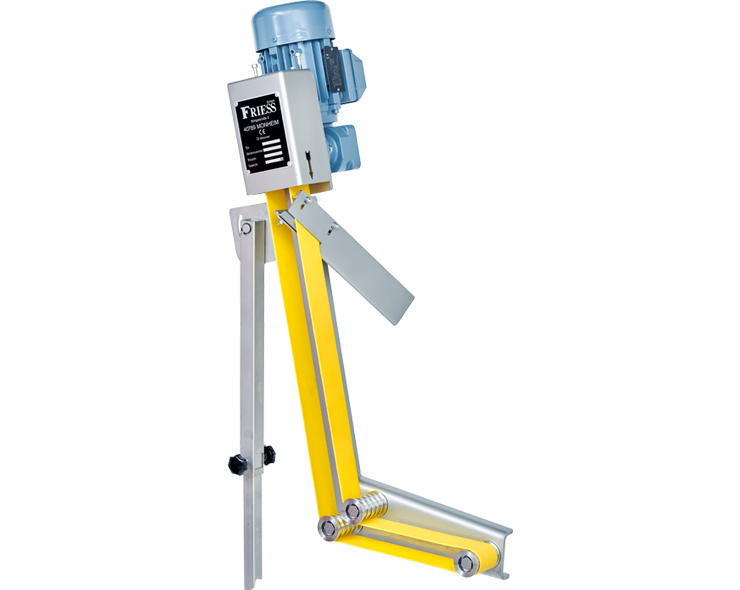
The angled belt skimmer builds on the advantages of the belt skimmer with a guided deflection pulley and takes it a step further. The angled belt of the angled belt skimmer makes flat contact with the liquid surface, setting it in motion and allowing oil to be drawn in and skimmed off over a larger area than with the vertically submerged belts of the standard belt skimmer. A common problem with belt skimmers is the limited “range” from which oil can be drawn toward the skimmer. The angled belt skimmer addresses this problem, as the belt’s angled—rather than vertical—immersion into the liquid creates a stronger suction effect on the liquid’s surface, thereby drawing in oil from a greater distance.
Click here for the WBS belt skimmer model → Product, datasheet download, and further information
Material
As with all products, the quality of belt skimmers varies widely depending on the manufacturer.
Substandard materials, short-lived drives, and poor construction can quickly turn a belt skimmer from an apparent solution to the tramp oil problem into a constant headache for maintenance. Skimmers from China, in particular, stand out in this regard—offered at rock-bottom prices.
Material: Depending on the application, the belt skimmer must be made of a suitable material. While aluminum or coated steel is often sufficient for cooling lubricants, stainless steel must always be used in degreasing or washing systems due to the more aggressive nature of the medium. Plastic or rubber scrapers should also be avoided at all costs, as they must be replaced quickly if particles are carried along with the oil.
Components
Drive: Inexpensive belt skimmers, in particular, are equipped with small 24V gear motors. However, these are often not designed for continuous operation and therefore tend to break down quickly. Compact 230V industrial gear motors offer far greater durability and cause fewer maintenance headaches.
Design: Although belt skimmers are designed to be very simple, there are still surprisingly many ways to get their design wrong. In addition to the two points mentioned above, there is a lot of room for error, particularly in the design of the drain channel. This is often designed as a small drain pipe. As soon as the oil becomes slightly thicker or contains particles, such a pipe clogs extremely quickly and must be cleaned regularly.
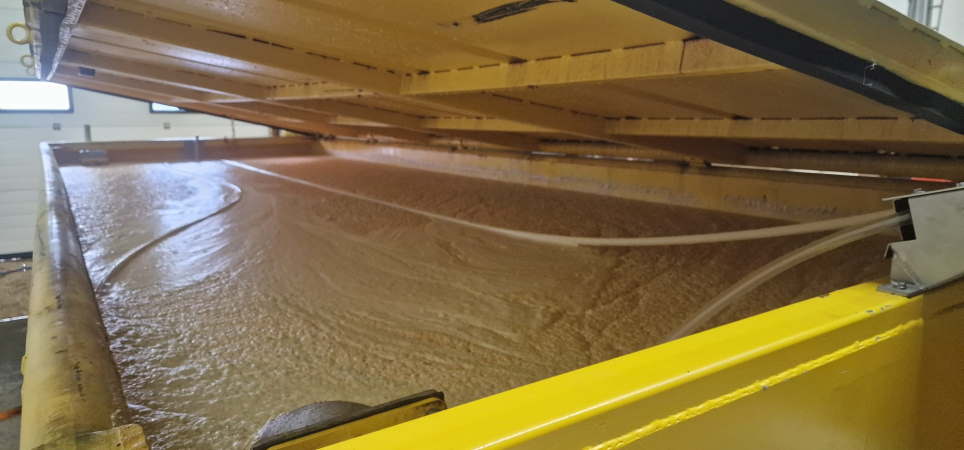 The skimmer hose is custom-cut to match the size of the tank, allowing it to remove floating fats and oils from the entire surface of the tank. This is the key advantage over a belt skimmer.
For larger tanks or basins, FRIESS offers various models of high-performance tube skimmers. Unlike belt skimmers, these are capable of covering the entire surface of a tank using a floating oil collector tube. The tube length is adjusted so that all areas of the tank can be reached, allowing the entire surface to be skimmed. Due to the continuous rotational movement on the liquid surface, the floating oil or grease film is removed across the entire tank surface.
Thanks to the special properties of the oil collector tube, floating light liquids adhere well to its surface.
Height differences of up to 20 meters between the skimmer and the liquid surface can be overcome, and fluctuations in liquid levels can be compensated.
The powerful FRIESS tube skimmers enable removal rates of up to 500 l/h and are also used in applications such as large wastewater treatment basins.
Here you can also find numerous application examples of FRIESS oil skimmers in various designs:
Overview of FRIESS oil skimmers
(belt skimmers and tube skimmers)
Special Features of FRIESS Belt Skimmers
Only high-quality materials are used. Thanks to the stainless steel housing and the industrial gear motor, a FRIESS belt skimmer can withstand highly aggressive liquids, which are often corrosive, alkaline, or acidic—such as various types of washing water. For this reason, FRIESS belt skimmers are not only successfully used in metalworking fluid treatment.
Many belt skimmers use a simple belt with two ends joined together. These connections are more prone to wear and result in a shorter service life of the skimmer belt. The endlessly woven, and therefore highly durable, skimmer belt from FRIESS is available in three different materials, providing an optimal and long-lasting solution for most physical requirements such as pH levels and temperature.
Buy Belt Skimmers from the Manufacturer FRIESS
For more than 50 years, we have been developing and producing high-quality oil skimmers (belt skimmers and tube skimmers) for a wide range of applications. We cooperate with specialist partners across Germany and internationally. If you would like to learn more about the process or ensure that your choice is the right one for your application, we will be happy to consult you.
Buying a Belt Skimmer – It’s That Easy
Go to our oil skimmer product overview and select the belt skimmer / oil skimmer you are interested in. Using the “Request inquiry” button, you can submit your contact details and we will send you the relevant information.
You are also welcome to call us during business hours and receive a consultation from our technical experts. Benefit from purchasing directly from the manufacturer.
Belt Skimmer Replacement Belt — Easy Reordering and Replacement in Case of Wear
Replacement belts are usually kept in stock and can be delivered quickly. Please note that seamless replacement belts (endless belts) are only available for FRIESS belt skimmers and not for skimmers from other manufacturers.
Conclusion
The tube skimmer operates with a hose that floats on the surface and absorbs the tramp oil. By selecting the appropriate hose length, all areas of the surface can be reached. A belt skimmer works differently: it reliably removes tramp oil in small tanks and is therefore the right choice for such applications.
The rotating belt is immersed vertically or at a slight angle into the liquid, where the floating tramp oil adheres to the belt. Belt skimmers deliver good results in tanks up to a maximum surface area of 0.5 m². For anything larger, the use of a tube skimmer is usually the better option.
FRIESS Oil Skimmers
With more than 50 years of experience in the treatment of process fluids, FRIESS oil skimmers stand for high efficiency, robust and durable designs, ease of operation, and low maintenance. They have proven themselves in thousands of projects. We offer models with different designs (belt skimmers and tube skimmers), each providing an optimal solution for a wide range of applications.