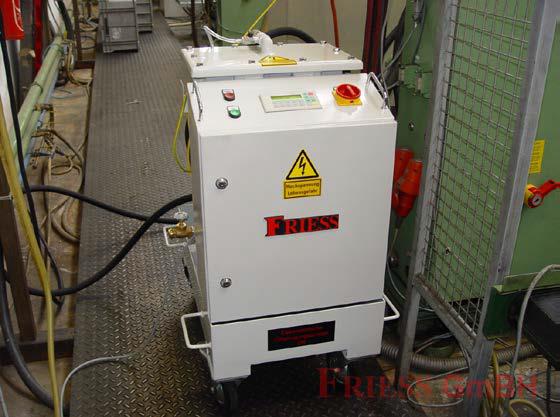
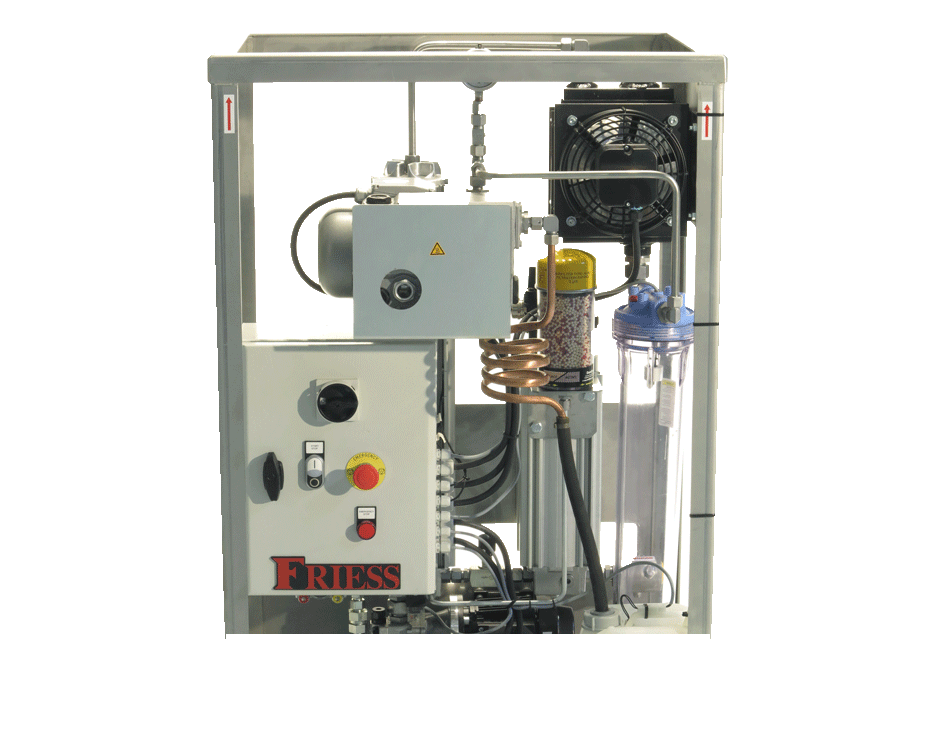
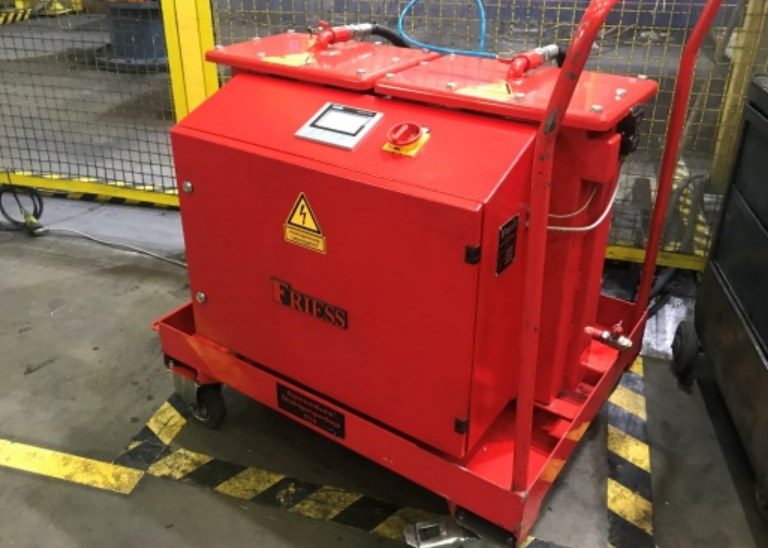
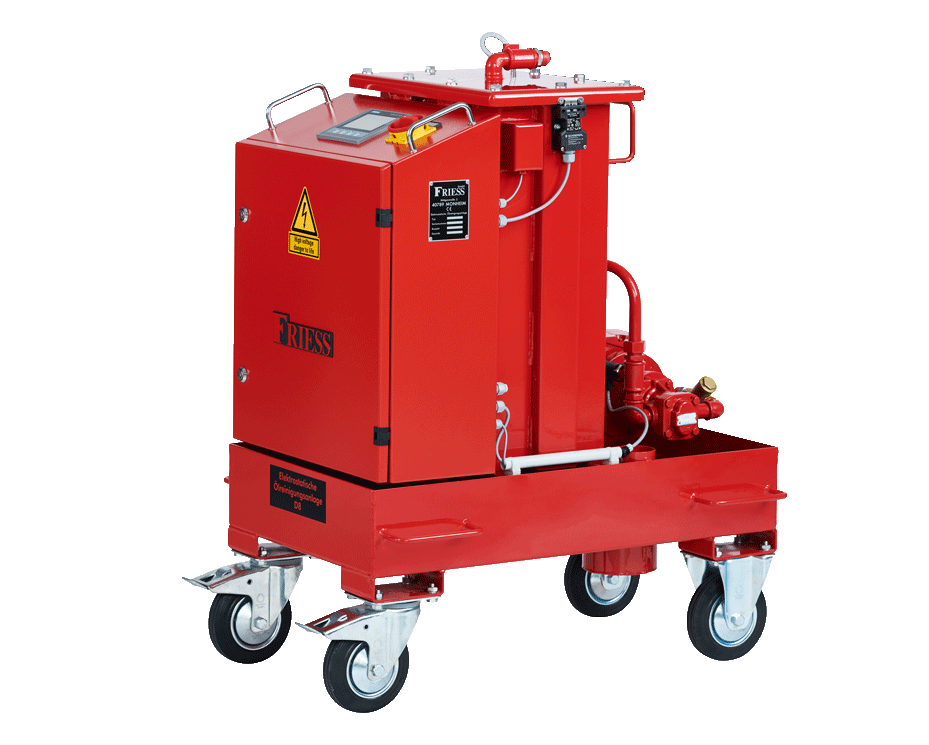
Electrostatic Oil Cleaners
Oil purification equipment for various oils with water content lower than 500 ppm.
Learn more

All of the best of “Made in Germany” without any of the worst of “Made in Germany.” Making your life – and our electrostatic oil filters – 10X easier.
What if you could have all the benefits of German engineering, precision, and materials without the high price, complexity or maintenance nightmares?
Electrostatic Oil Cleaning Systems from FRIESS remove particles as small as 0.1 µm and aging phenomena such as varnish and oxidation products. This not only increases the service life and durability of the oil, but simultaneously optimizes machine precision and reduces hydraulic malfunctions.
How does Electrostatic Cleaning work?
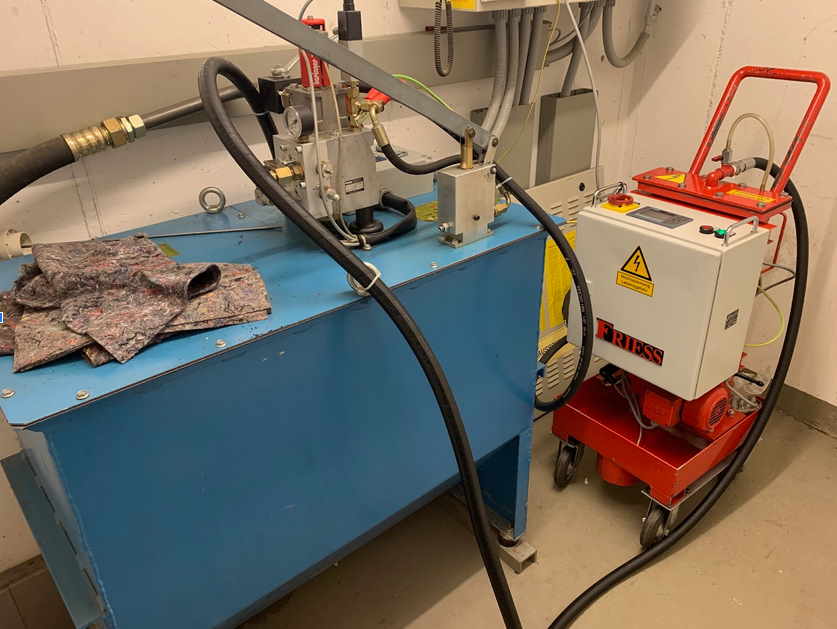
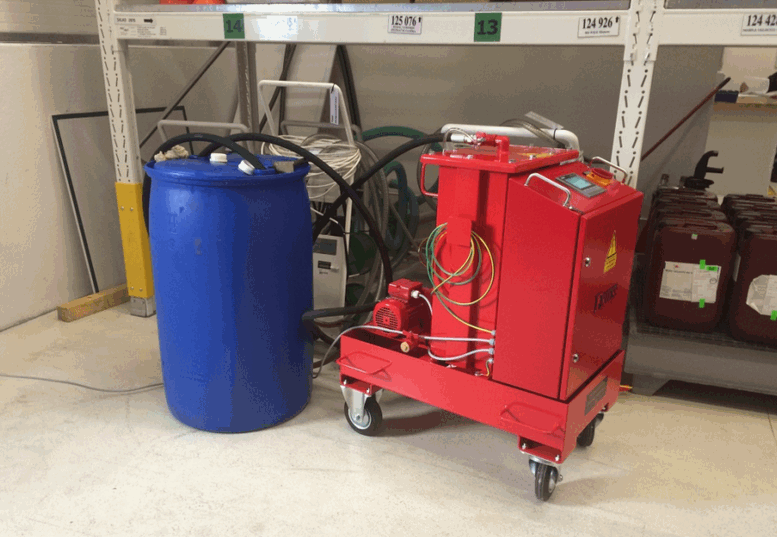
Our Oil Cleaning System is connected to the oil tank in a bypass flow. The oil is then transported from the reservoir to the Electrostatic Oil Cleaning System by means of a gear pump. There, electrodes charged with a voltage of 14,000 V ensure that contaminants contained in the oil are attracted and deposited on cleaning elements. The innovative FRIESS principle removes both hard contaminants such as metal particles, seal abrasion or chips, and soft contaminants such as oxidation products, varnish and sticky sludge particles.
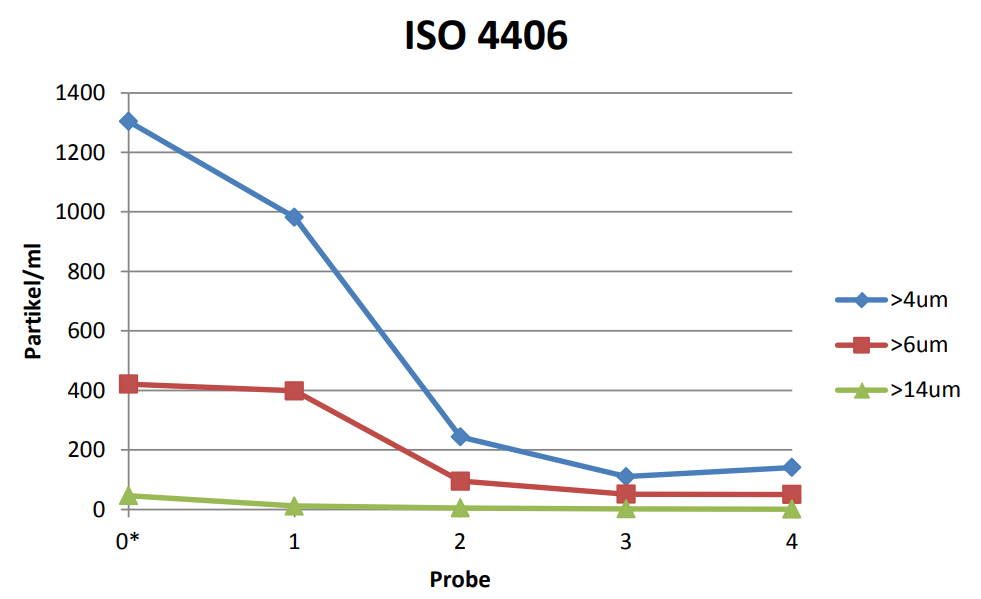
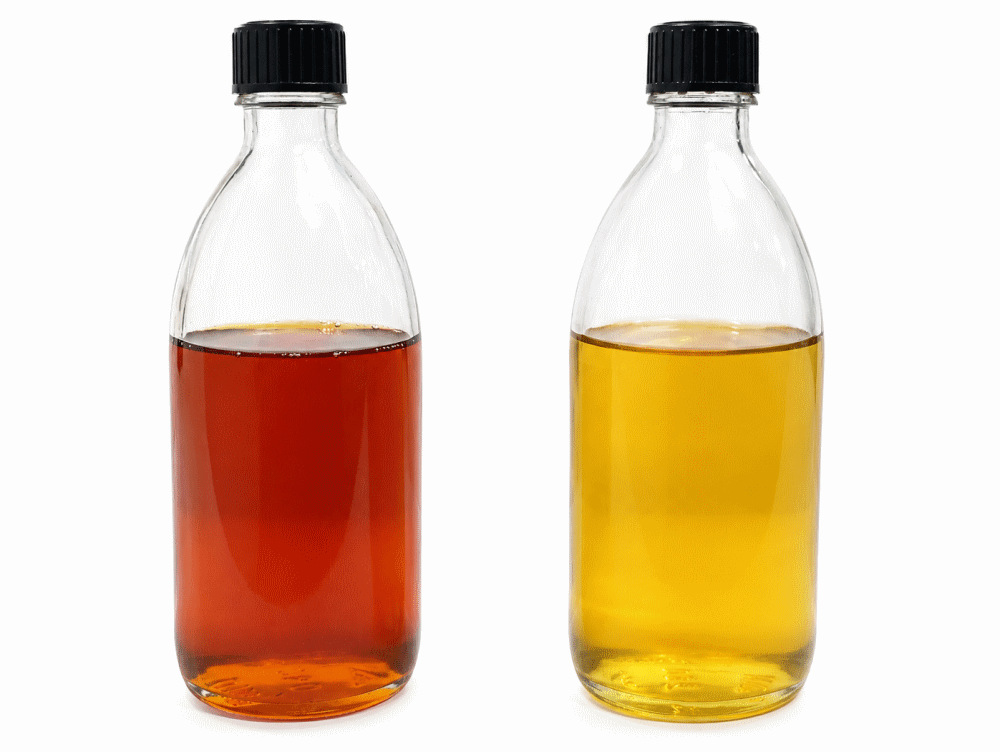
The special feature of this method is that you are not limited by the pore size of your filter elements. Unlike other filters, the field forces of an electrostatic field act on particles of all sizes. As a result, you get a particularly clean oil that is even cleaner than new oil! Thus, you save yourself expensive and time-consuming oil changes.
The advantages at a glance:

Content:
Below, you will learn how to:
For over 20 years, our customers have relied on FRIESS electrostatic hydraulic oil filtration. They come from a wide range of industries, including steel and metal, plastics injection molding and processing, automotive, paper, as well as energy and power generation.
Particles in hydraulic oil have an abrasive effect and accelerate wear on pumps, motors, pistons, and valves. This results in more frequent malfunctions, costly repairs, and, in the worst case, production downtime.
Conventional hydraulic oil filters only remove contaminants above a certain particle size. Fine particles and oil degradation products are particularly problematic, as standard filtration systems do not remove them sufficiently.
The rule is simple: The more precisely a hydraulic component operates, the cleaner the hydraulic oil needs to be.
Manufacturers therefore specify certain cleanliness grades for their components. The required oil cleanliness for the entire system is generally determined by the most sensitive component – for example, a proportional valve.
Effective hydraulic oil filtration should reliably maintain this specified cleanliness grade over the long term. Keeping the oil clean can also extend its service life many times over while significantly reducing the effort and costs associated with oil changes and disposal.
Malfunctions related to poor or contaminated oil quality can occur throughout virtually the entire hydraulic system. Components with tight clearances, moving sealing surfaces, and small control passages are particularly susceptible.
Particle contamination is one of the most significant causes. Metal abrasion, dust, or other solid contaminants can cause wear on pumps and cylinders and, in particular, block valves.
Water in hydraulic oil can cause corrosion, reduce lubricity, and accelerate oil degradation. Pumps, in particular, can suffer damage due to cavitation. For this situation, we also offer our oil dehydration system to reduce the water content to an acceptable level!
Oil degradation and oxidation lead to the formation of acids, sludge, and lacquer-like deposits. These so-called varnish deposits are particularly problematic in precision valves.
Incorrect viscosity can also cause malfunctions. Oil that is too thin, for example, increases internal leakage and wear, while oil that is too thick can lead to poor suction, high pressure losses, and sluggish movements.
While conventional hydraulic oil filters retain particles through the pores of a filter medium, FRIESS electrostatic oil cleaning uses an electrostatic field.
A high voltage is applied between two electrodes to generate an electrostatic field. This field acts on the charged contaminants in the oil and directs them toward special collectors, where they are deposited.
The key advantage of an electrostatic hydraulic filter is that separation does not depend on the pore size of a filter medium. This means that even extremely fine particles that pass through conventional filters can be removed.
Soft contaminants and oil degradation products such as varnish and resins are also reliably removed without clogging the conventional filter pores of the hydraulic filter.
This means that EFR technology goes beyond simple particle filtration: the hydraulic oil is continuously cleaned and freed from degradation products – ensuring clean, high-performance oil over the long term.
Suspended varnish is removed by the electrostatic hydraulic filter:
The oil effectively regains its capacity to absorb contaminants. This creates a concentration gradient between the degradation products present in the oil and those already deposited on surfaces.
Existing deposits can gradually dissolve again.
Some of the varnish/resin deposits are gradually picked up by the oil flowing past and brought into suspension. These substances are then carried with the oil to the EFC hydraulic filter, where they are removed.
This process is repeated continuously.
As a result, existing deposits can be gradually reduced over an extended period. At the same time, the formation of new deposits is counteracted.
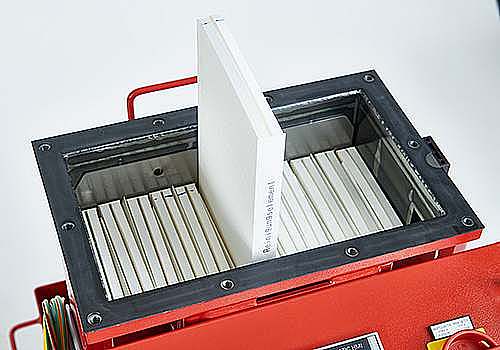
Unused large-surface filter elements with high dirt-holding capacity in the electrostatic filter chamber.
The generously sized filter chamber provides a high dirt-holding capacity, allowing for long operating periods before the filter material needs to be replaced.
Thanks to the easy access to the FRIESS hydraulic filter, the cost-effective filter material can be replaced quickly and the level of contamination can be assessed directly – for simple and efficient maintenance.
The unused filter elements provide a large surface area for capturing contaminants, enabling long service life in the electrostatic filter chamber.

Despite the use of conventional filters, the result shows which contaminants would still remain in the oil without FRIESS EFR hydraulic oil filtration.
These deposits also include contaminants that were not captured by conventional hydraulic filters. The condition of the filter element clearly demonstrates how effectively the EFR hydraulic filter works.
Despite the use of existing conventional filters, the used filter element clearly demonstrates which contaminants would still remain in the hydraulic oil without the FRIESS EFR hydraulic filter.
Since the EFR hydraulic oil filter operates in a bypass system, the filter elements and electrodes are easily accessible at all times. Maintenance can be carried out without interrupting the operation of the hydraulic system.
Maintenance requirements depend on the level of contamination. We recommend an initial inspection after approximately 2,000 operating hours, and recommended maintenance intervals are conveniently displayed on the unit.
The electrostatic hydraulic filter operates fully automatically during normal operation but can also be controlled manually when required. The clearly structured menu enables simple and intuitive operation.
The large-surface filter elements have a high dirt-holding capacity. As a result, the EFR hydraulic filter requires comparatively little consumable material – providing long service life, low maintenance requirements, and low operating costs.
The key sustainability benefits are:
The key sustainability benefits are:
With FRIESS, you don’t have to commit right away. Test electrostatic oil cleaning in your own facility first or take advantage of our flexible leasing options.
As an alternative to purchasing outright, we offer attractive leasing options including spare parts service. This allows you to benefit from electrostatic oil cleaning without having to make the entire investment upfront.
Contact us – together, we’ll find the right solution for your system.
These factors give you significant potential savings by taking proper care of your oil.
Clean oil also helps reduce damage to valves and other components, which in turn avoids downtime.
Damage, oil costs and downtime account for a large portion of the cost of operating a hydraulic system. With a significant reduction in these costs, hydraulic systems can be operated far more profitably as they no longer incur so many costs.
Although our systems work comparatively slowly, they can keep your oil cleaner than the new oil you receive!
Depending on the amount of oil and the price per liter, an oil cleaning system can pay for itself within 2-3 months if one oil fill is saved and thus no longer needs to be changed.
In most cases, an oil purification system will have paid for itself within a year. This is due to the savings in oil purchase and disposal, as well as the reduced failure frequency of expensive components in the system.
Basically, we recommend that as long as the oil and your system are not too dirty and the oil still meets the necessary chemical requirements, it is worth cleaning the oil.
However, since every system is different, we cannot make a generalized statement without any data. We would be happy to help you make a more accurate determination.
We would be happy to tell you what they are!